Curiosities
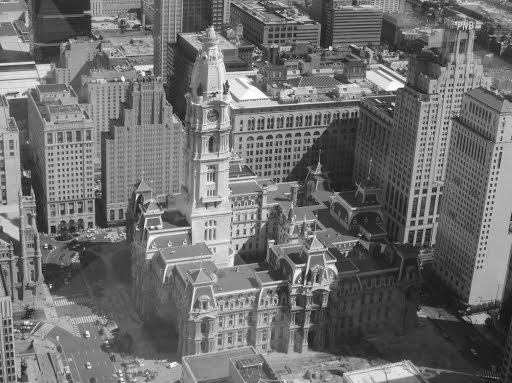
Beneath a clear blue 9/11 sky—it was almost too blue, like it was that Tuesday in September twelve years earlier—I climbed to the top of Philadelphia’s (and Pennsylvania’s) tallest office tower in search of an urban legend. I wanted to see with my own eyes what I had been telling people for years. Not that I ever doubted that the story was true. As we all know, William Penn works in mysterious ways. The story I tell is familiar to Philadelphians and delightful to visitors hearing it for the first time. For almost one hundred years the tallest man-made object in the City of Philadelphia was the bronze Quaker hat atop the head of Pennsylvania founder William Penn in the thirty-seven-foot-tall statue that crowns the top of City Hall Tower. At a height of 548 feet from street to hat, City Hall Tower was the tallest building in the world (briefly) until it was surpassed in 1889 by that Parisian erector set on steroids, the Eiffel Tower. City Hall Tower still retains the title of world’s tallest “habitable” masonry structure, and its status as Philadelphia’s tallest building was enforced for decades, not by law, but rather by an understanding, an unseen handshake between corporate and political leaders who agreed to abide by what was known as the “Billy Penn Hat Rule.”
Looking at Center City’s vaunted skyline today, where City Hall Tower is a slender, almost insignificant presence, it’s hard to believe it once dominated the downtown, with the statue of William Penn ruling over the glass and stone buildings below him like a peaceful bronze colossus. All that changed in 1987 with the completion of One Liberty Place, the sixty-one-story blue glass Chrysler Building look-alike crowned with a steel spire that tops off at a height of 945 feet. If the massive bronze shoulders of William Penn weren’t already in that position, he would have turned his back on the young upstart and all the other higher-than-thou-hat skyscrapers that popped up during the past two decades. And sometime during that first decade—no one is exactly sure when and the man responsible isn’t talking—William Penn put a curse on Philadelphia and its ungrateful citizens. He wouldn’t let any of the city’s professional sports teams win a national championship.
He had his reasons beyond being upstaged in the skyline. In 1993 when the Phillies went to the World Series, the city put a big red Phillies hat on top of Billy Penn’s bronze hat. The Phillies lost in six games. Lesson: Don’t be mocking the man’s hat. In 1997 when the Flyers went to the Stanley Cup finals, they put an orange hockey jersey on William Penn. He’s a Quaker, for crying out loud! The Flyers were swept in four games. Lesson: Don’t be mocking a man’s faith. In 2001 when the Sixers made it to the NBA finals, nobody did anything to William Penn but he still wouldn’t let us beat the Lakers. Lesson: The man don’t forget. But five years later, something Comcastic happened to the Center City skyline with the opening of Philadelphia’s (and Pennsylvania’s) tallest and greenest skyscraper in June of 2008. Months earlier during the topping off ceremony of the Comcast Center, along with the traditional evergreen tree and American flag, iron workers placed a small replica statue of William Penn on a steel I beam and hoisted it to the highest point on the tallest building in Philadelphia almost a thousand feet above street level, with William Penn now back on top. And guess who won the World Series that year? The Phillies. Lesson: At the end of the day, the man is still a fan.
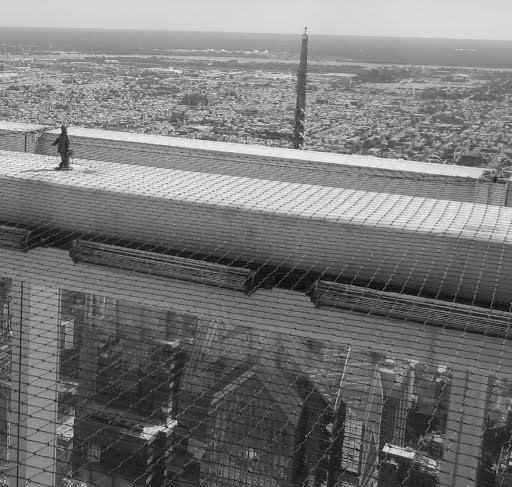
Billy Penn was back where he belonged. Top of the world, Ma! “We know how to take care of our curses in Philadelphia,” I like to tell out-of-towners, who invariably ask, “Is it still there?” To which, I happily reply, “Of course. Who would dare remove it?” Only an idiot. Possibly a New York Mets fan. But no properly loyal and reasonably superstitious Philadelphia sports fan would ever mess with William Penn again, right? But then I heard that some diabolical nitwit had stolen the statue of William Penn on top of the Comcast building. Say it ain’t so! “It’s true,” said John Demming, senior director of corporate communications for Comcast. Demming discovered the theft when he was taking a camera crew to the roof a few years ago to shoot video of the statue. It fell to Demming to find a replacement statue, which wasn’t so easy, but he was successful at last. And on September 11, 2012, he took me to the roof of the Comcast building to see with my own eyes. It’s quite a schlep, incidentally, and it’s not a tourist attraction. Guided by Kelly Argo of Liberty Property Trust, which owns and manages the building, Demming and I and three others rode a freight elevator to the fifty-sixth floor followed by four flights of stairs up to the unoccupied fifty-seventh floor. Then began the seventy-five-foot climb up ten flights of stairs to the roof of the Comcast tower. And on the highest beam on the south side of the rooftop, stood a six-and-three-quarter-inch-tall bronze statue of William Penn, facing northeast, just like the larger Penn statue way, way below. What a view of the city. Never in my life have I seen City Hall look small. From up there it did. From the new top of the city where little Billy Penn reigns, and will continue to—”Oh, we’ve got him epoxied down on that beam,” said Demming—I could see the cooling tower of the Limerick nuclear power plant forty miles away and miles beyond that. From up there, shoulder to shoulder with William Penn surveying his domain, Pennsylvania looked pretty darn good.
(Photos by Clark DeLeon.)