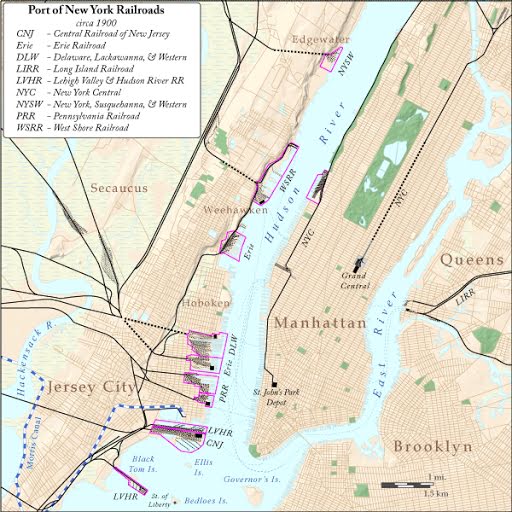
Pavonia Terminal was the Erie Railroad terminal on the Hudson River situated on the landfilled Harsimus Cove in Jersey City, New Jersey.
History
The Erie began developing the waterfront site in 1856. The intermodal complex was built between 1886 and 1889. Across the river-facing facade was New York, Lake Erie and Western Railroad , the name of the entity that built it, though it was also called Jersey City Terminal Station or Erie Railroad Station The colloquial name is taken from the 17th century European settlement of Pavonia, New Netherland which began in the area and the ferry that served it. It has been described as "a brightly colored Victorian eclectic three story terminal located at the foot of Pavonia Avenue to serve a twelve track" station. The end of track was at about 40.7266 N 74.0304 W. Besides the railroad, the complex was served by ferries, streetcars and the rapid transit Hudson and Manhattan Railroad (now PATH). The terminal was also used by New York, Susquehanna and Western Railway trains. Long distance and suburban passenger trains reached the terminal by travelling through Bergen Hill via the Long Dock Tunnel and later under the Bergen Arches. In 1956 the Erie Railroad began moving its operations out of the Pavonia Terminal and into the Delaware, Lackawanna and Western Railroad's Hoboken Terminal, and by 1960 had merged to become the Erie Lackawanna Railway. Erie's Northern Branch trains moved to Hoboken in 1959; the New York, Susquehanna and Western operated to the terminal until it pulled back to Susquehanna Transfer in 1959. The terminal was razed in 1961.
Service
Lines
The Erie Railroad's Main Line ran from Jersey City to Chicago via Binghamton and Youngstown; with a line to Buffalo, and a line to Akron with a spur to Cleveland. The name and a portion of the route exists in the form of the New Jersey Transit Main Line to Suffern, New York and, under contract for Metro North, all the way to Port Jervis. Parts of the contemporary Bergen County Line and Pascack Valley Line were also Erie operated, while sections of its Greenwood Lake Branch have been incorporated into the Montclair-Boonton Line. The Northern Branch is another line from the Erie era along which freight is transported and that may be revived as light rail service. The last train to leave the station, the #1205 at 6:35 p.m. on Friday, December 12, 1958 was along the Northern Branch. The Paterson and Newark Branch and the Orange Branch were also parts of its suburban network. The New York, Susquehanna and Western Railway main line ran to Wilkes-Barre, although passenger service was operated that far for only a few years (and that Wilkes Barre and Eastern line was completely abandoned, even for freight service, in 1939), while regular commuter service ran only to Butler, NJ until 1966.
Ferry
The Pavonia Ferry began running in 1851, along a route that had been established some decades earlier as Budd's Ferry. It was taken over the by Erie and sold to the Pavonia Ferry Company of Jersey City for what was considered a low price of $9,050, at New York City Hall, in February 1854. In February 1859 Nathaniel Marsh of the Erie Railroad Company purchased the lease on behalf of the Pavonia Ferry Company. He started a ferry which ran from Chambers Street (Manhattan) to the foot Pavonia Avenue on the other side of the Hudson River. Legal problems had prevented the Pavonia Ferry Company from establishing a ferry along this route. The New York and Erie Railroad paid an annual rent of $9,050 to transport passengers back and forth. Eventually the railroad constructed its Pavonia Terminal on the land-filled Harsimus Cove. Suburban and long distance travelers would transfer from trains to boats for the passage across the river. Its final two routes from the terminal across the Hudson to Lower Manhattan, one to 23rd Street and another to Chambers Street. Many streetcar systems began at the Manhattan side of the many ferries that at landed there. The Metropolitan Street Railway system began after the merger of the Chambers Street & Grand Street (Manhattan) Ferry Railway and the Houston Street (Manhattan), West Street & Pavonia Ferry Railroad, on January 30, 1891. The roads were capitalized for $800,000 and $250,000 respectively, totaling a combined capital of $1,050,000. A January 18, 1903 letter from a Passaic, New Jersey reader to The New York Times , commented about the inadequacy of the boats of the Pavonia Ferry, which was then the property of the Erie Railroad. All their boats are old, small and entirely inadequate to accommodate the crowds during rush hours. The vessels then in use by the Erie Railroad, listed with first year of service, were Pavonia ( 1861), Susquehanna ( 1865), Delaware ( 1868), Chatauqua ( 1868), Passaic ( 1869), Ridgewood ( 1873), Paterson ( 1886), and J.G. McCullough (1891). New York Waterway re-introduced service to Pier 79 at West 39th Street on December 1, 2006.
Streetcar
Numerous streetcar lines that served the station. Eventually they (and indeed all of Hudson County lines) were operated by the Public Service Railway. The Grove Street, which operated between Exchange Place and Hudson Place (Hoboken), passed nearby. The Pavonia and the Crosstown originated at the station. The Hudson Bergen Light Rail Pavonia/Newport Station opened in 2002, and is located one and half blocks west of the PATH system.
H & M tube station
Originally named "Erie", the PATH's Newport station, originally built by the Hudson and Manhattan Railroad (H&M) still bears the letter "E" engraved on its pillars. Opened on August 2, 1909 the station was built with only the island platform. The side platform was added around 1914 to handle the heavier passenger volume. It was closed in 1954 in order for the bankrupt railroad to reduce costs. The side platform remained dormant for nearly 50 years. The northernmost stairway exit from the two platforms led to a steep passageway which originally went directly to the Erie Railroad terminal. In the 1920s a second passageway and mezzanine area was built over the existing platforms and northbound trackway. This second passageway and mezzanine area were also closed in 1954 (as was also the entrance to/from Henderson Street), but was reopened in the late 1980s/early 1990s after the station was renovated. Also in 1954 the first moving sidewalk, or travellator, in the United States was installed. Named the "Speedwalk" and built by Goodyear, it was 277 feet (84 m) long and moved up a 10 percent grade at a speed of 1.5 miles per hour (2.4 km/h). The walkway was removed a few years later when traffic patterns at the station changed.
Site
Site of former terminal across the Long Slip. Ventilation tower is part of Holland Tunnel, which contributed to the demise of terminals along the west bank of the North River . For contemporary ferry service from Pavonia, see New York Waterway. For contemporary rapid transit service from Pavonia, see Port Authority Trans-Hudson. For contemporary trolley service from Pavonia, see HBLR. The complex was built on the northern portion of landfilled Harsimus Cove. The southern part was the Pennsylvania Railroad abattoir and freight yard. A narrow slip kept that name, while another called the Long Slip was created and separated it from Hoboken Terminal. The only visible trace of the Erie's waterfront complex that remains today is part of the right of way/viaduct which carried trains from the foot of the Palisades escarpment to the waterfront. Part of it runs parallel to Boyle Plaza (the toll plaza for the Holland Tunnel) and is used for motor vehicular traffic to the Newport Section of the city.

 OpenBuildings